Most devtool companies are invisible when developers decide.
I write implementation-first tutorials that get your tool into Google, AI answers, and the developer communities they consult before they decide.
Published and working with





Your product isn't hard to use.
Developers just can't find proof when it matters.
Developers don't evaluate tools by reading your docs. They search for someone who has already solved their specific problem with your tool.
They search on Google. They ask their AI coding assistant. They check Reddit for an honest take. They look for a tutorial on FreeCodeCamp or DEV.to from someone who has actually built with it.
If your tool isn't in those places with content that matches their exact problem, they find a competitor who is.
Developers search for solutions, not products
When a developer is stuck, they type a problem into Google or ask an AI tool for help. They're not looking for your product by name. They're looking for a solution. Your content needs to be that solution.
AI coding assistants recommend what they have context for
When a developer asks Cursor or Claude which tool to use, the assistant defaults to tools with the most implementation content on trusted platforms. If your tool isn't in that content, it isn't in the recommendation.
Company blogs are the last place developers trust
Developers trust FreeCodeCamp, DEV.to, Reddit, and HackerNoon over company blogs — unless the company has earned Stripe or Supabase-level authority. Most developer tool companies haven't.
How I build content that reaches developers.
Not from your docs outward. From their confusion inward.
Step 1 — Find the real question
Before writing anything, I search Reddit and developer communities for the exact questions developers are asking about the problem your tool solves. Not what your product team thinks they're asking. What they're actually typing at 11pm when they're stuck.
Step 2 — Build a real use case
I build a working project using your tool around that specific problem. Not a "hello world". A use case a developer would actually ship — with the edge cases, trade-offs, and workarounds that only show up when you actually build.
Step 3 — Write the implementation
I document what I built: what worked, what didn't, and how to replicate it. The result is a tutorial that reads like it was written by a developer who solved this problem, not a writer who read your docs.
Step 4 — Publish where developers search
The tutorial goes where developers and AI tools look for implementation content: FreeCodeCamp, DEV.to, your company blog, or a combination. Structured for search, structured for AI parsing, structured for the developer who needs a working answer fast.
Reddit Insight
"How do I extract text from a scanned PDF in a Next.js app without hitting Vercel's timeout limits?"
Implementation
Google Ranking #1
"How to Build a PDF Text Extractor with Next.js"
freecodecamp.org · 4 min read
The difference between content that ranks and content that sits.
Most technical content is written from the docs outward. It covers what the product does. It follows the happy path. It assumes developers are ready to proceed.
Real developer adoption happens when a developer finds content that matches the exact problem they're trying to solve, shows them a working implementation, and gives them enough context to trust the tool before they've committed to using it.
That's what implementation-first content does.
What most tutorials do:
Introduce the product.
Show a basic example.
Link back to the docs.
Result: The developer understands what the product does. They still don't know if it solves their specific problem.
What I build instead:
Start from a real developer problem.
Build a working solution using the product.
Document every decision, trade-off, and edge case.
Result: The developer finishes the tutorial having already solved their problem with your tool. Adoption happens inside the content, not after it.
Content that works in the real world.
"I like your conversational style."

Quincy Larson
Founder, FreeCodeCamp
Community Solutions
A tutorial I wrote for a client covers a use case their official docs didn't address. Developers in the relevant subreddit are actively asking for exactly this solution.
Google Ranking #1
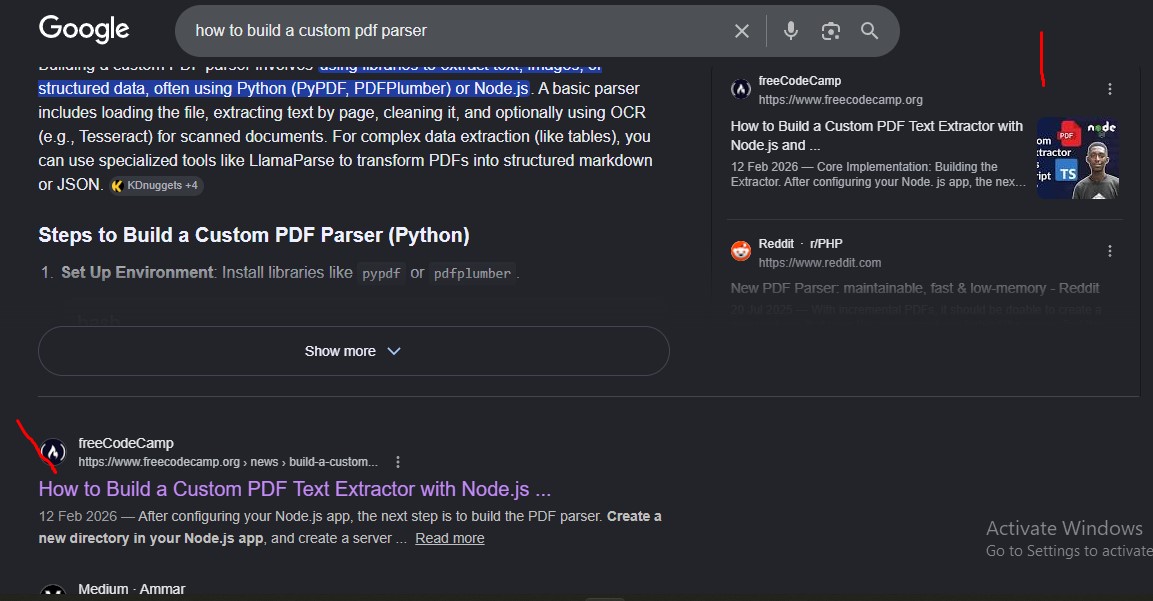
My FreeCodeCamp article on building a custom PDF text extractor ranks #1 on Google for its target keyword and appears in AI search results.
AI & Search Visibility
Ghostwritten tutorials I've built for developer tool clients appear in AI overviews and rank for competitive search queries their developers are running.
Trusted Contributor
Accepted to contribute to FreeCodeCamp and JS in Plain English on first application to both.
Live SEO Performance
"How to Build a PDF Text Extractor with Next.js"
freecodecamp.org/news/handling-forms-nextjs-server-actions-zod/
Target Keyword Volume
95% Visibility
How we can work together.
Most engagements start with one of these.
Option 1 — Reddit Pain Point Research
I analyze the developer communities where your target audience is most active and surface the exact questions and objections your current content isn't answering.
Best for: Teams who want to know what to write before committing to writing it.
Option 2 — Implementation Tutorial
One end-to-end tutorial built from real developer behavior in your product's problem space. Researched from Reddit, built from scratch, written for the developer who is searching for a solution your tool provides.
Best for: Teams who have just launched a new integration or feature and need content that reaches developers during evaluation.
Option 3 — Ongoing Content
A recurring engagement covering research, writing, and publication across the platforms that reach developers during evaluation. Structured around the developer questions your tool needs to be the answer to.
Best for: Teams ready to build a sustained presence in the places developers search.

Hi, I'm Chidera.
I'm a frontend developer turned technical content strategist. I write implementation-first tutorials for developer tool companies building in APIs, auth, AI tooling, and frontend infrastructure.
I started writing technical content because I was a developer who kept being failed by content that explained what a tool did without showing how to use it for a real problem.
I write the tutorials I wished existed. That's the quality bar.
Most devtool companies are invisible at the moment developers decide which tool to use.
If that's the problem you're sitting with, let's talk.
We'll spend 15 minutes identifying where your tool is missing from the developer's decision process and what one piece of content would change that.
Book a fit call